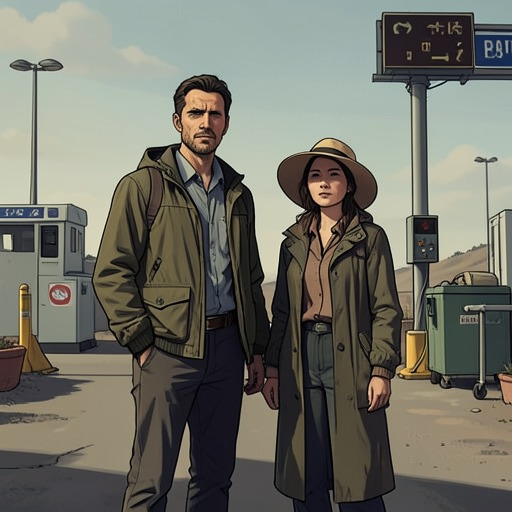
The narrator and Izumi’s flight to Greece
Blind Willow, Sleeping WomanThe narrator and Izumi’s flight to Greece begins in the wreckage of their affair and turns a desperate proposal into a decisive break with their former lives. After both are left by their spouses, they leave Japan together, carrying their savings and little else; on the flight, the narrator’s fear that his suitcase might be mistaken for someone else’s becomes a terrifying sense that he himself has vanished. The journey offers no simple escape or clean renewal, but it does bring a moment of release as the Aegean appears beneath the plane.
The collapse that precedes the decision
The decision follows the exposure of the narrator’s relationship with Izumi. His wife refuses to accept his distinction between his love for Izumi and his marriage, leaves for her parents’ home in Chigasaki with their son, and will not speak to him. Her father takes the calls instead and says he will not allow his daughter to return to a man he condemns; his opposition to the marriage, present from the beginning, now seems confirmed.
Izumi, too, is left alone. Her husband has gone after striking her and cutting up every piece of clothing she owns, from her overcoat to her underwear. She tells the narrator that she is exhausted, that everything is ruined, and that her husband will not return. They had been high-school sweethearts. The narrator wants to comfort her but cannot find anything to say. The affair has not led them into a secure new relationship: it has placed both of them amid the wreckage of marriages and made their shared future suddenly uncertain.
An escape proposed at dawn
After lying alone in bed for several days, the narrator meets Izumi for a drink. They spend the night in Shibuya, drinking vodka gimlets and daiquiris at an all-night bar, but for the first time since they met they have little to say. At dawn they walk to Harajuku and have coffee and breakfast at a Denny’s. It is there that Izumi proposes Greece, a destination she has wanted to visit for years and had imagined as a honeymoon trip, but could not afford at the time.
For Izumi, leaving is both a long-held wish and a way out of a country that, she believes, will only depress them. She proposes that the two of them live in Greece without worrying about anything and let the future sort itself out. The narrator has no particular interest in Greece; what moves the decision is not a newly discovered love of the destination, but the possibility of leaving the circumstances that now seem impossible to repair.
They calculate their resources together. Izumi has two and a half million yen in savings, and the narrator can provide one and a half million, for a total of four million yen, which they reckon at about forty thousand dollars. Izumi estimates that discounted tickets would cost around four thousand dollars and that a thousand dollars a month could support them in the Greek countryside for three years—or two and a half years to be safer. The plan is improvised, but its arithmetic gives their flight a concrete shape: they are not merely talking about leaving; they are measuring how long they can stay away.
The narrator looks around the early-morning restaurant, where the other couples are young and he and Izumi are the only pair over thirty. They are contemplating fleeing Japan with all their money after a disastrous affair. He looks at the palm of his hand and wonders how his life has come to this. He eventually agrees. The proposal does not resolve the damage behind them; it converts bewilderment into action.
Resignation and the logic of discarding
The next day, the narrator submits his resignation. His boss has heard rumors and had already decided that extended leave would be best for the time being. His colleagues are surprised, but no one makes much effort to persuade him to stay. The ease of quitting gives the narrator a stark realization: once he decides to discard something, there is little he cannot let go. The thought grows more absolute as he considers it. Getting rid of one thing makes him want to shed everything else, like a gambler who, having lost nearly all his money, risks what remains because holding on has become too much trouble.
That impulse is visible in the preparations. The narrator packs what he thinks he needs into one medium-sized blue Samsonite suitcase; Izumi takes roughly the same amount of luggage. Their departure reduces a life to what can be carried, while the narrator’s own reflection makes the reduction feel less like tidy planning than a willingness to abandon nearly everything.
The suitcase and the crisis of self
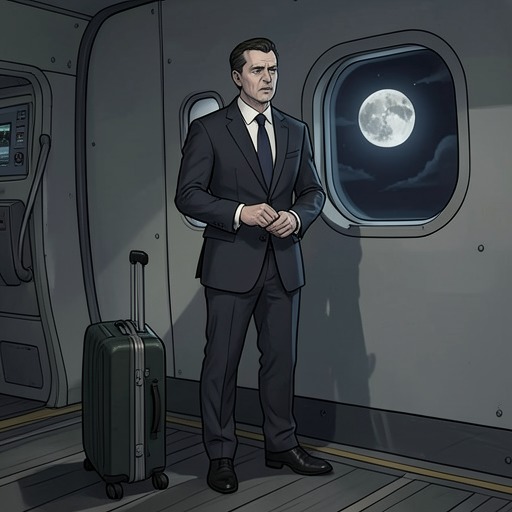
While the plane is flying over Egypt, the narrator suddenly fears that someone else has taken his bag by mistake. There must be tens of thousands of identical blue Samsonite cases in the world, he thinks; in Greece he might open his and find a stranger’s possessions. The fear expands beyond the loss of belongings. If the suitcase disappears, he feels, nothing will connect him to his former life except Izumi, and he experiences himself as though he has vanished.
The narrator imagines that his mind has attached itself to a convenient outer package that only resembles him. The body he occupies seems made of plaster, liable to flake apart if scratched, and he shakes uncontrollably despite the airplane’s air-conditioning. He sweats, his shirt sticks to his skin, and he thinks he smells awful. Izumi holds his hand and occasionally embraces him without speaking; she seems to understand how he feels. The episode lasts about half an hour. At its height, the narrator wishes he could die, imagining a gunshot that would reduce both mind and flesh to dust.
The crisis turns the practical act of travel into a rupture in identity. The suitcase that carries his possessions is also the object around which he fears losing any connection to himself. Yet after the shaking subsides, the movement of the journey continues. He relaxes his shoulders, gives himself over to time, and falls asleep. When he wakes, the azure waters of the Aegean lie below the plane. The sight does not erase the terror, but it marks the first release from it: after imagining that he no longer exists, he arrives at the destination Izumi proposed.
The unfinished promise of departure
The flight establishes the terms of their escape: it is shared, materially planned, and emotionally unsettled. Izumi’s Greece is a deferred dream and a proposed refuge; for the narrator, the destination initially matters less than leaving behind a life whose familiar ties have broken. His resignation and single suitcase make that abandonment tangible, while the fear over the identical cases reveals how precarious his sense of self has become.
The Aegean offers a threshold, not proof that their troubles are over. The evidence of the departure shows the couple choosing to live abroad with limited savings, but the narrator’s severe anxiety also makes clear that physical distance cannot immediately settle the inner dislocation they carry. The journey ends this episode with an arrival and a temporary loosening of panic, leaving the larger promise of escape unresolved.